Currently Empty: £ 0.00

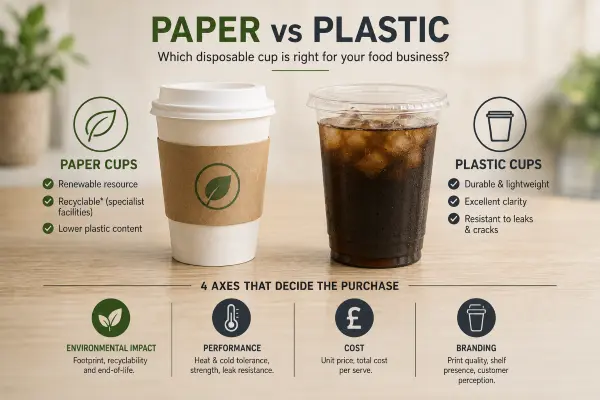
Disposable cups are single-use drink containers made either from paper board with a thin lining or from moulded plastic, sized for takeaway service. Neither type wins outright. Paper leads on one set of measures, plastic on another, and the right pick depends on what your food business values most. Four axes decide the purchase: environmental impact, performance, cost, and branding. Each section below sets paper against plastic on one axis, then a short framework near the end helps you match a cup to your own menu. Read it as a supplier would brief you, not as a sales pitch.
Environmental impact: carbon footprint vs biodegradability
Across a full life cycle, paper and plastic cups land close together, and neither is clearly greener. A UNEP Life Cycle Initiative review of single-use cup studies found PE-lined paper cups broadly comparable to recycled plastic (rPET), with manufacturing as the largest impact stage for both. Water use and land use pull in different directions as well: paper leans on forestry and freshwater, plastic on crude oil and refining.
The quick view below sets the two side by side before three questions break the picture apart: how much does production cost the planet, how fast does each break down, and can either be recycled. For the wider effect of paper cups on the environment, the same three questions apply.
| Measure | Paper cup (PE-lined) | Plastic cup (PET / PP) |
| Raw material | Renewable wood pulp plus a thin PE lining | Fossil-based polymer |
| Manufacturing burden | Higher: pulping uses water and energy | Lower per unit, close to recycled plastic |
| Break-down once littered | Weeks to a few years for the fibre | Decades to centuries |
| Recycling route | Specialist paper mills only | Kerbside where councils accept the polymer |
| Microplastics risk | Lower | Higher |
Carbon footprint and production resources
In manufacturing, the stage that dominates a cup’s life-cycle footprint, paper carries a heavy load. Turning wood into cup board means pulping, bleaching and drying, and each step draws water and energy. Recycled fibre and FSC-certified board trim that load, since less virgin pulp means less water and energy at the mill. Life-cycle studies collated by UNEP place PE-lined paper close to recycled plastic on climate impact, so paper holds no automatic advantage at the factory gate. This is one axis of four, and the picture shifts the moment a cup is thrown away. The carbon footprint of paper cups sits mostly in this production phase, not in the coffee run itself.
Biodegradability, landfill and microplastics
Once binned, paper fibre breaks down far faster than plastic, which can persist for decades. Two points keep this from being simple. First, paper buried in low-oxygen landfill releases methane, a greenhouse gas stronger than carbon dioxide over the short term. Second, plastic does not vanish; it fragments into microplastics. Microplastics are plastic pieces under 5mm that spread through soil, water and the food chain. So faster break-down does not mean harmless, and slow break-down carries its own long tail. That raises the obvious question: is recycling the way out?
The recyclability reality
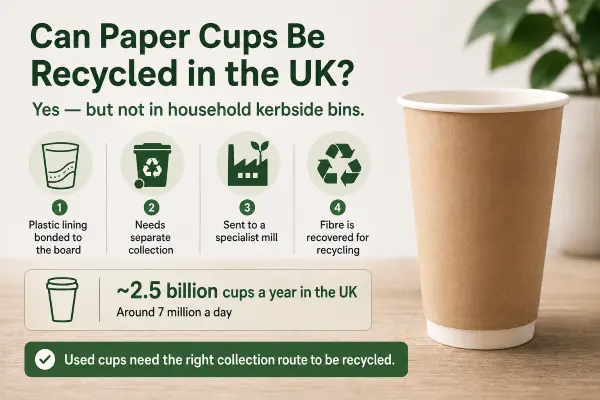
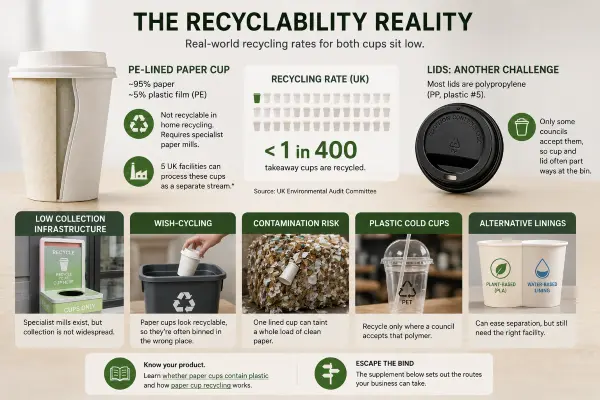
Real-world recycling rates for both cups sit low. A PE-lined paper cup is roughly 95% paper and 5% plastic film, and that film stops standard kerbside systems separating the fibre. It can be recycled, but only through specialist paper mills, not the home bin, and it is not widely collected. The National Cup
Recycling Scheme lists five UK facilities able to process these cups as a separate stream. Even so, the UK Environmental Audit Committee reported fewer than 1 in 400 takeaway cups are recycled. Lids add a second problem: most are polypropylene (PP, plastic #5), which only some councils take, so cup and lid often part ways at the bin. Because a paper cup looks recyclable, it is also one of the most wish-cycled items, and a single lined cup can taint a whole load of clean paper.
Plastic cold cups recycle only where a council accepts that polymer. Plant-based (PLA) or water-based linings ease the split but still need the right facility. Before that, it helps to know exactly whether paper cups contain plastic and how paper cup recycling works. So how does a business escape this bind? The supplement below sets out the routes.
Performance: hot vs cold drinks
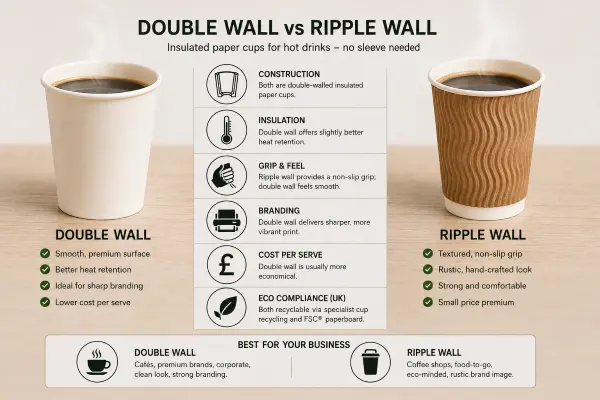
Match the cup to the drink, and performance sorts itself out. A double wall paper cup (double wall means two paper layers with an air gap that slows heat transfer) holds temperature and stays comfortable in the hand, which suits hot service. Plastic is clear and rigid, shows off layered cold drinks, and shrugs off the leaks that come with melting ice. The table maps common drinks to the stronger cup.
| Drink | Stronger cup | Why |
| Flat white, tea, hot chocolate | Double wall or ripple paper | Heat retention, safe grip |
| Iced latte, cold brew | Clear plastic or cold paper cup | Shows the drink, resists leaks |
| Smoothie, milkshake | Plastic with a dome lid | Room for toppings, rigid walls |
| Espresso, cortado | Small single wall paper | Right size, low cost per unit |
For hot-led menus, browse paper cups for hot drinks; for iced and blended lines, cold drink paper cups cover most of the range. Leak resistance and grip count as much as heat. A double wall keeps the outer surface cool through a long hold, and a well-matched lid stops splashes on the move, which is the detail a customer remembers. Performance settles half the choice. The till settles the other half.
Cost and unit economics for businesses
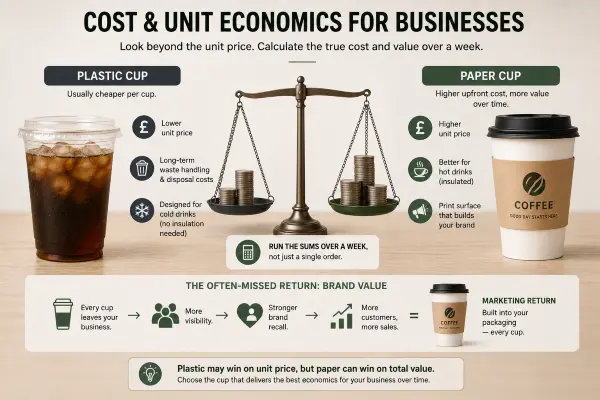
Per cup, plastic is usually the cheaper buy. Paper costs more because the board and lining that hold heat cost more to make, and most plastic cups serve cold drinks where insulation is not needed. Two figures rarely show on the invoice, though. Plastic carries longer-term waste-handling and disposal costs, and paper carries a print surface that builds the brand every time a cup leaves the counter. Run the sums across a week rather than a single order, and the gap in cost per paper cup narrows. A printed sleeve or a branded wrap adds a few pence, yet it turns a plain cup into repeat exposure, so part of the marketing spend now sits inside the packaging line rather than a separate ad budget. There is one return a cup delivers that few operators count: brand value.
Branding and customer perception
On branding, paper holds the edge. Its surface takes full-colour print cleanly, so a logo, house colours and a short message sit sharp on the cup. Plastic prints poorly and often reads as low effort. Think of a takeaway cup as a mobile billboard: once it leaves your counter it travels the high street, the office and the bus, carrying your name past hundreds of eyes. Print quality and the care a cup signals feed straight into how customers judge the shop. With EcoLife logo coffee cups and print-on-demand, a small café can run branded stock without a large minimum order. Fold the four factors together, and the answer for your business starts to appear.
Which cup fits your business: a decision framework
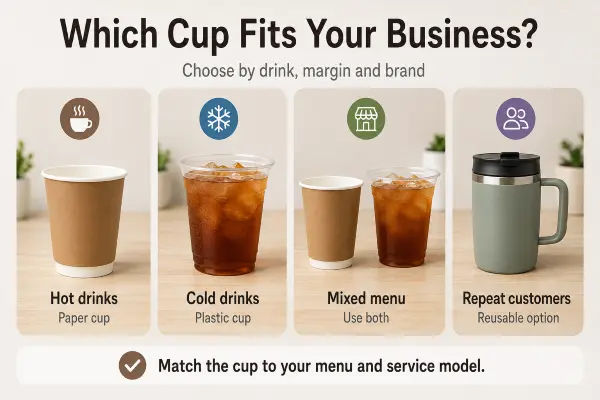
Pick by matching each cup’s strength to your menu, your margin and your brand. Five rules cover most food businesses:
- Choose paper if you serve mostly hot drinks and lead with brand, such as cafés and coffee shops.
- Choose plastic if you serve mostly cold or layered drinks, such as juice bars, smoothie counters and bars.
- Pick each where its strength fits the drink; a flat white belongs in insulated paper, an iced latte in clear plastic.
- Skip the weaker fit; a hot-drinks café gains little from thin plastic, and a cold bar rarely needs insulated paper.
- Step past both where a fixed site and repeat customers make reusable or plastic-free cups pay off over time.
Still unsure which grade suits you? Our guide to how to choose the right paper cups and our pick of the best paper cups for coffee shops walk through sizes and wall types. When you are ready to buy, EcoLife supplies wholesale paper cups in the UK with a low MOQ, dispatch within 24 hours, and print-on-demand. Request a quote or get a free sample pack, and order from just 500 units with free UK delivery over £80.
How can a business move to a lower-impact cup without overpaying?
You can lower a cup’s impact without a price spike by looking at three routes: plastic-free cups, reusable cups, and a hybrid of the two. Each fits a different setup, and none asks you to gamble your margin. The two sections below take them in turn.
Beyond the binary: plastic-free and compostable paper cups
A third option sits beside standard paper and plastic. Plastic-free and compostable cups swap the PE film for a plant-based PLA layer or a water-based coating, which can make composting or recycling easier. The conditions matter, and honest labelling matters more. Compostable means certified to break down in a composting system, not simply left to rot anywhere. Most compostable cups need industrial composting, which is not present across every part of the UK, and not every bin will do. Water-based and plastic-free claims still need certification, and some coatings keep a polymer content. The table sets the linings side by side.
| Lining | Compostable | Recyclable | Condition |
| PE (standard) | No | Yes, specialist mill | Separate collection stream |
| PLA (plant-based) | Industrial only | Limited | Commercial composter needed |
| Water-based coating | Sometimes | Easier than PE | Depends on local facility |
Reusable and hybrid models: where they beat both single-use options
For a fixed site with regular returning customers, reusable and hybrid models beat both single-use cups over the long run. A deposit-return scheme, or a small discount when a customer brings their own cup, cuts both cost and waste once volume builds. Run the numbers on a break-even point: after a reusable cup is used enough times, its per-serve cost drops below any single-use option. The condition is steady footfall: the model rewards repeat visits, so it suits a settled café more than a one-off event stall. See reusable vs disposable cups and practical steps for reducing single-use cup waste.
Is a plastic-free paper cup always the greener choice? Not always. A plastic-free cup only earns its edge where collection and composting exist. If it ends up in general waste and is buried, most of the benefit is lost. The disposal route decides the outcome as much as the cup does.
When the greenest cup is no disposable cup at all
Sometimes the lowest-impact choice is no single-use cup at all. A refill into a customer’s own flask, or a washable mug for anyone drinking in, removes the cup from the sum entirely. It will not fit every counter, yet for a settled site it is the one move that beats the paper-versus-plastic question by stepping around it. The UK single-use plastic rules already push in this direction, so the shift also keeps you ahead of regulation. For the current legal position, the GOV.UK single-use plastics guidance sets out which items a food business may still supply.
Frequently asked questions
What is the difference between paper cups and plastic cups?
Paper cups use wood-pulp board with a thin lining, come from a renewable source, and break down faster once binned. Plastic cups use oil-based polymer, resist damage, stay clear, and last far longer in the environment.
Are paper cups better for the environment than plastic cups?
Not necessarily. Life-cycle studies put the two close together. Paper breaks down faster after disposal, while plastic often carries a lower manufacturing burden. The greener pick depends on how each cup is made and how it is thrown away.
Which is cheaper for a business: paper or plastic cups?
Per cup, plastic is usually cheaper, since paper board and lining cost more to produce. Over time, paper narrows the gap through print branding and perceived quality that support repeat custom and marketing value.