Currently Empty: £ 0.00

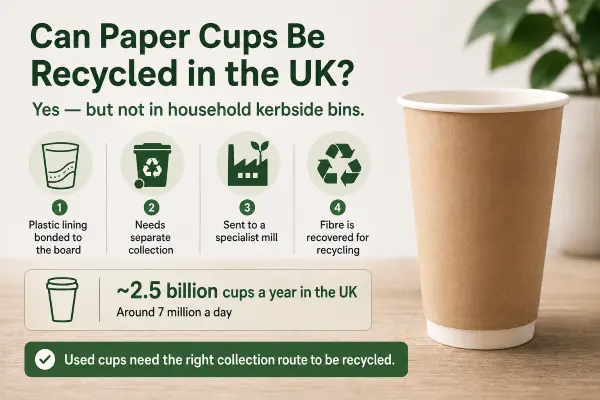
Paper cups can be recycled in the UK, but not through your household kerbside bin. A thin waterproof lining bonds to the board, so a used cup needs a separate collection route to reach a specialist mill.
The country gets through about 2.5 billion disposable cups a year, close to 7 million a day, according to WRAP and the House of Commons Environmental Audit Committee. This guide explains what the lining is, how to prepare a cup, where to take it, how the mill recovers the fibre, and how a food business sets up its own collection.
EcoLife Packaging, a UK factory-direct supplier, makes food-safe, recyclable paper cups for exactly this route. The confusion starts with one question almost every buyer asks first.
Can Paper Cups Be Recycled?
Yes, paper cups are recyclable, but only through out-of-home collection rather than standard household recycling. A cup is roughly 95% paper board bonded to a thin plastic lining, which is why its route differs from ordinary paper and card.
Recovery rates used to be low: a 2019 WRAP study found only about 2.8% of fibre-based composite cups were recycled. UK capacity has since grown enough to process every cup placed on the market, so the limit now sits with collection rather than technology.
The reason the household bin is the wrong destination lies in how sorting works.
Why Household Recycling Bins Reject Paper Cups
Most council kerbside systems cannot separate the lining, so a cup dropped into a paper or mixed bin is screened out as contamination. A single lined cup placed in hope rather than knowledge, the habit called wishcycling, can spoil an otherwise clean load of paper.
Kerbside rules also vary by council, so local guidance always overrides general advice. The obstacle is not the paper at all, but the microns-thin layer that keeps your drink from leaking.
How the Plastic Lining Jams Standard Paper Mills
Ordinary paper mills pulp fibre in water, and the fused plastic film resists that separation and blocks the screens, so the whole cup is rejected. Specialist mills run a modified process that releases the fibre from the lining, which is the reason cups need a dedicated route.
Which lining a cup carries decides everything about where it can go, so it helps to know what yours is made of. See Do Paper Cups Have Plastic for the material breakdown.
What Are Paper Cups Lined With?
The lining is the coating that lets a cup hold liquid without leaking, and four types dominate the UK market, each with a different end-of-life. Knowing which one a cup uses tells you which recycling route applies. A fuller reference sits in Paper Cup Materials & Linings Explained.
Start with the traditional lining still found on most cups.
Polyethylene (PE) Lining
Polyethylene is the traditional oil-based film used to waterproof most paper cups. It cannot be separated at ordinary mills and is the lining most kerbside systems reject, so a PE-lined cup needs a specialist cup facility.
This is the coating on the majority of takeaway cups sold today. A plant-based alternative has grown popular, though it carries its own condition.
PLA (Plant-Based) Lining
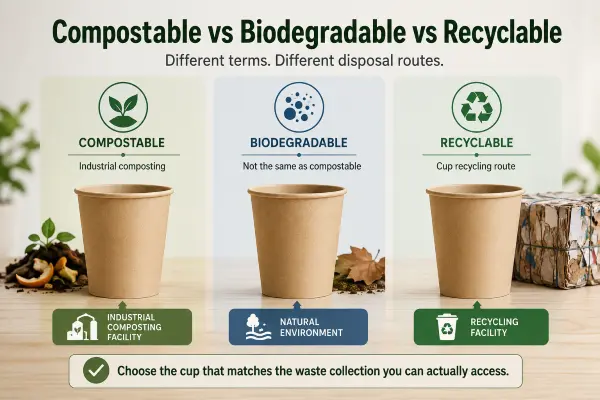
PLA, or polylactic acid, is a bioplastic made from corn or sugarcane, using fewer fossil resources than PE. Its key caveat is the end-of-life: a PLA-lined cup breaks down only in an industrial composting facility, not a home bin or standard recycling, and behaves like a contaminant if mixed into ordinary streams.
The difference between the two coatings is set out in PLA vs PE Lining. A newer, water-based option changes the picture again.
Water-Based (Aqueous) Lining
An aqueous lining is a water-based coating that is recyclable as a material and can be processed at home or industrially. UK mill infrastructure for it is not yet widespread, so a specialist facility stays the reliable route today.
The gap between what is technically recyclable and what current UK infrastructure accepts matters, and Water-Based Lining Paper Cups covers it in depth. For the lowest-friction end-of-life, some cups now drop the film altogether.
Unlined and Fibre-Only Paper Cups
A fibre-only cup carries no PE or PLA film, which gives it the widest set of disposal options and the easiest recycling. Some suppliers describe such cups as plastic-free, a label that depends on the exact coating, so check the specification before you rely on it.
For a business that puts recyclability first, an unlined or mineral-coated cup is the type to specify. Knowing the lining is half the task; the other half is handling the cup correctly.
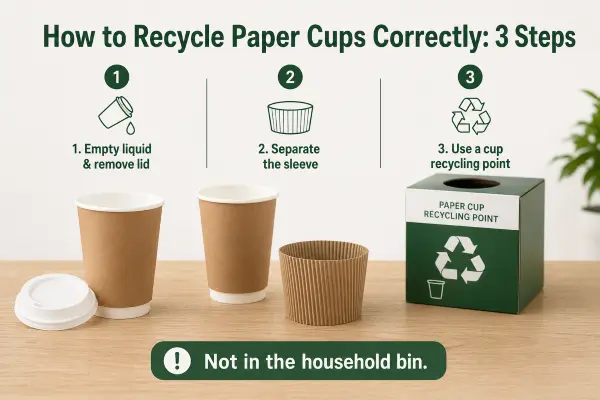
How to Recycle Paper Cups Correctly: 3 Steps
Preparing a cup properly is what turns it from packaging into recoverable fibre. Three quick actions get a cup ready for its dedicated stream.
- Empty any liquid and remove the lid.
- Separate the cardboard sleeve.
- Place the cup in a dedicated cup recycling point, not the household bin.
Empty the Cup and Take Off the Lid
Empty the cup first, because dregs contaminate the fibre stream, though a rinse is not needed. Take off the lid and send it to its own rigid-plastic stream, since most lids are polypropylene rather than paper.
Keeping the two materials apart protects both from ending up as general waste.
Separate the Cardboard Sleeve
Slide off the corrugated sleeve, which is ordinary card with no lining. Once removed, the sleeve goes straight into standard paper recycling, unlike the cup body.
This small step keeps clean card out of the specialist cup stream, where it is not needed.
Use a Dedicated Cup Recycling Point
Place the empty cup in a dedicated cup recycling point rather than a general paper bin, because cups have to be collected separately to reach a specialist mill. On-the-go bins and coffee-shop collection points are the correct destination.
These points fall into three clear types across the UK.
Where to Recycle Paper Cups in the UK
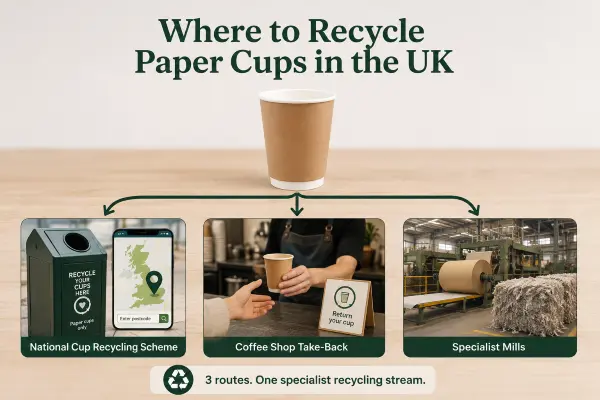
Three routes exist for recycling a paper cup in the UK, and each one feeds the same specialist mills. The backbone of all three is one national scheme.
The National Cup Recycling Scheme
The National Cup Recycling Scheme launched in April 2018, set up by Costa Coffee and now co-funded by seven brands including McDonald’s, Caffè Nero, Pret A Manger, Greggs, Burger King, Pure and Lavazza Professional.
It pays waste collectors a supplement of about £70 per tonne to gather cups as a separate stream, and runs a postcode locator for the nearest drop-off. That funding turns a low-value item into one worth collecting.
Many of those funders also take cups back over their own counters.
High Street Coffee Shop Take-Back
Costa, McDonald’s, Pret A Manger, Caffè Nero and Greggs accept used cups of any brand for recycling in participating stores. You can return a cup wherever is convenient, not just where you bought it.
In-store bins feed the same separate collection that reaches the mills. When neither a scheme bin nor a shop is nearby, a facility route still exists.
Specialist Cup Recycling Facilities
A small number of UK mills, among them James Cropper, DS Smith and ACE UK, use technology that separates fibre from lining, and scheme collections funnel cups to them. Capacity already exists to recycle every cup on the market once cups are collected correctly.
The bottleneck is collection, not processing. It helps to see what happens once a cup reaches one of these mills.
How Are Paper Cups Recycled Inside a Specialist Mill?
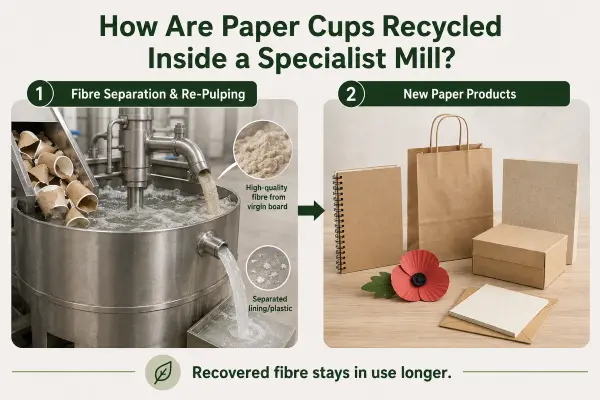
Inside a specialist mill, a cup passes through two stages: the fibre is released and cleaned, then remade into new products. The process recovers material that ordinary mills cannot.
Fibre Separation and Re-Pulping
The mill drops cups into a pulper where water and agitation loosen the fibre from the lining, and the plastic is then screened out, leaving clean pulp. Cup fibre is high quality because cups are made from virgin board for hygiene, which makes the recovered material valuable.
That quality is why mills pay to receive well-collected cups.
What Recycled Paper Cups Become
The recovered fibre is remade into new paper products, from packaging board and stationery to notebooks, bags and even Remembrance Day poppies. Cup fibre can be recycled several times over before the strands become too short to reuse.
Each cycle keeps the material in use and out of landfill. Understanding the process is one thing; running it at a café is another.
How to Set Up Paper Cup Recycling for Your Business
A café, takeaway or office sets up a clean cup stream in three moves: choose a collection partner, position clearly signed bins, and brief staff and customers. Done well, it doubles as a compliance measure and a loyalty signal.
The full playbook sits in How to Set Up Paper Cup Recycling. Choosing the right partner is where a clean cup stream begins.
Choosing a Cup Collection Partner
Look for a partner offering transparent, auditable collection, a route matched to the lining your cups use, and volumes that suit a small operator rather than only large contracts. A route built for low-MOQ buyers keeps the scheme workable for an independent site.
Match the partner to your cup, not the other way round.
Signage and Staff Training for a Clean Cup Stream
Clear bin signage and a short staff routine keep the stream free of contamination, which is what mills need to accept the load. Publicising the effort can also bring repeat custom, since customers increasingly notice how a business handles waste.
Clean collection and customer goodwill tend to arrive together. Collection is the reliable route, but it is not the only way to cut cup waste.
How Does Recycling Compare With Other Ways to Cut Cup Waste?
Recycling handles a cup at end-of-life, while reuse and material choice cut waste further upstream. Both angles matter, and the comparison and rules below show how they fit together. Weighing those options side by side makes the trade-offs clear.
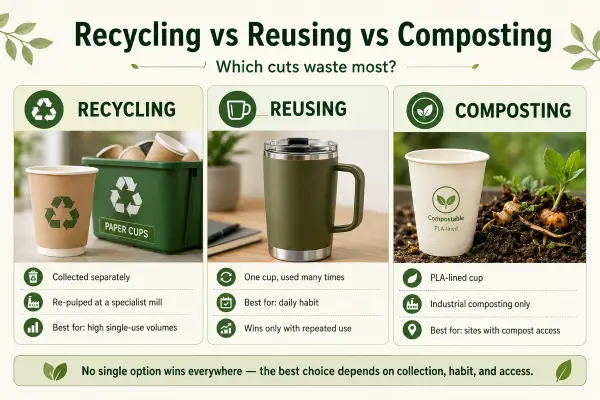
Recycling vs Reusing vs Composting: Which Cuts Waste Most?
Each option suits a different situation, and none wins outright.
| Option | How it works | Best when |
| Recycling | Cups are collected separately and re-pulped at a specialist mill | High single-use volumes that can be collected cleanly |
| Reusing | A durable mug replaces many single-use cups | Genuine daily habit, since a mug must be reused enough to pay back its footprint |
| Composting | PLA-lined cups break down in an industrial composting facility | Access to industrial composting, not home or kerbside |
One caveat governs reuse: a reusable cup only beats single-use once it has been used enough times to offset its larger footprint, a break-even that runs from roughly 20 uses for a reusable plastic cup to well over 100 for steel or ceramic, according to Zero Waste Scotland. Habit, not ownership, is what makes reuse win.
Compare the two directly in Reusable vs Disposable Cups. These choices increasingly sit inside a framework of UK and EU rules.
The Rules Shaping Cup Waste in the UK and EU
Policy now shapes cup choice as much as cost does, through a plastic tax and a set of single-use rules. The most-asked policy question concerns tax.
Does the UK Plastic Packaging Tax Apply to Paper Cups?
The UK Plastic Packaging Tax targets plastic packaging with less than 30% recycled content, charged at £228.82 per tonne from 1 April 2026, up from £223.69 the year before. A paper cup is mostly board, so it sits differently against that threshold, with the thin lining as the relevant factor rather than the whole cup.
Full detail sits in UK Plastic Packaging Tax Explained, and the cost picture in Plastic Cups vs Paper Cups (Cost & Tax).
Single-Use Plastic Rules and the EU Directive
UK single-use plastic restrictions and the EU Single-Use Plastics Directive both push businesses toward lower-plastic packaging. In December 2024, DEFRA scrapped its planned mandatory cup take-back scheme, citing a £52 million cost and limited recycling gains, so voluntary collection now carries the load.
The UK picture is covered in Single-Use Plastic Rules UK and the EU side in EU Single-Use Plastics Directive. Beyond the rules, buyers still ask a handful of recurring questions.
Paper Cup Recycling: Frequently Asked Questions
A few yes/no questions come up again and again, each with a short, direct answer.
Can You Reuse a Paper Coffee Cup?
Not for long: a single-use paper cup is not built for repeated use, as the lining degrades and hygiene drops after the first drink. For genuine repeat use, a proper reusable mug is the better choice. Light reuse at a desk is possible but short-lived.
Are Kraft Ripple Cups Recyclable?
Yes, kraft ripple cups follow the same rule as other lined cups: recyclable through specialist cup collection, not the household bin. The kraft outer is fibre-based, and the insulating ripple layer does not change the route.
More detail sits in Are Kraft Ripple Cups Recyclable.
Can You Put Ceramic or China Cups in Recycling?
No, ceramic and china are not accepted in standard recycling, because they melt at different temperatures from glass and contaminate the stream. An intact mug is best reused or donated, while a broken one goes to general waste.
Do Paper Cups Contain PFAS or BPA?
Reputable food-grade cups are made to avoid intentionally added PFAS and BPA and are produced to recognised food-safety standards. If you supply cups, ask your supplier for that documentation. The safety detail sits in Do Paper Cups Contain PFAS or BPA.