Currently Empty: £ 0.00

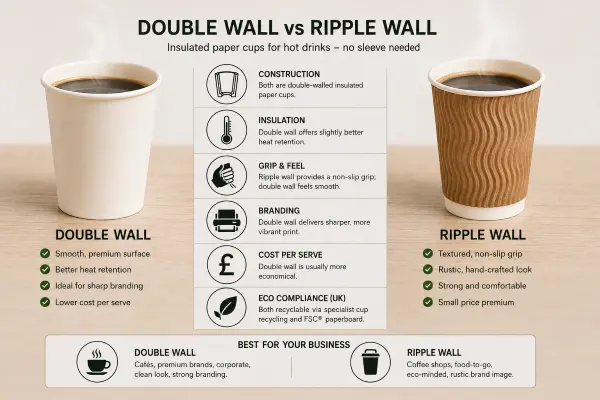
Both ripple wall and double wall paper cups are insulated paper cups that hold hot drinks safely and remove the need for a separate cardboard sleeve, so the real choice comes down to three things: how the cup feels in the hand, how sharply it prints your brand, and what it costs per serve. Double wall gives a smooth, premium surface and a marginal edge in heat retention.
Ripple cups give a textured, non-slip grip and a rustic, hand-crafted look, usually at a small price premium. This guide compares the two across construction, insulation, grip and durability, branding, cost-per-serve, UK eco compliance, and the business models each suits best.
The Key Takeaway
Choose double wall for a smooth surface, sharp full-wrap printing, and slightly longer heat retention; choose ripple wall for a firm grip and a rustic look, usually at a marginally higher unit price. Both are sleeve-free, both stack neatly, and both come in 8oz and 12oz. Use the table below to scan the differences before the detail.
| Feature | Double wall | Ripple wall |
| Construction | Inner cup plus a smooth outer wall with a sealed air gap | Inner cup plus a corrugated outer wall trapping air in the flutes |
| Insulation | Strong; marginally longer hot-hold from the continuous air gap | Strong; air held throughout the ripples |
| Grip and feel | Smooth, classic, premium | Textured, firm, non-slip |
| Print surface | Smooth; suits full-wrap and fine detail | Textured; suits bold, rustic designs |
| Relative cost | Slightly lower unit price | Usually a little higher |
| Best for | Chains, premium cafes, corporate catering | Food trucks, events, rustic cafes |
How Each Cup Is Built
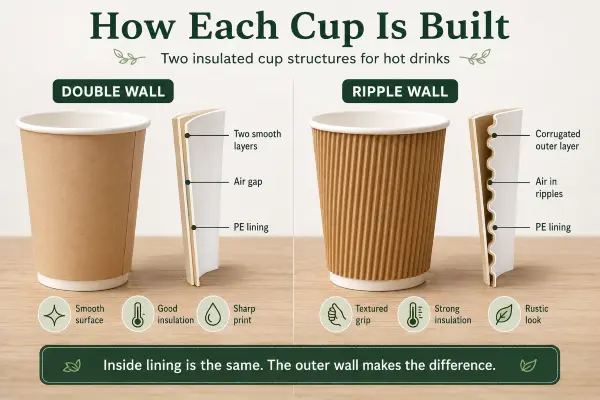
Both cups pursue the same goal, a comfortable hold on a hot drink without a sleeve, yet they reach it through different outer walls. Both are paper cups with a food-safe polyethylene (PE) lining on the inside, so the construction differs on the outside, not on the surface that touches the drink. A cross-section is the clearest way to see it: two smooth walls with a gap, or one smooth wall wrapped in ripples. The wall you choose shapes insulation, grip, print quality, and price, so it is worth understanding before you order.
Double Wall With Two Smooth Layers and an Air Gap
A double wall paper cup bonds a second smooth paper wall around the inner cup, leaving a thin sealed air gap between the two. That trapped air is the insulator, holding heat in and keeping the outer surface cool enough to grip. Double wall uses a heavier board than single wall paper cups, which adds rigidity and leak resistance at the seam and rolled rim. The smooth outer wall is the foundation for crisp, full-wrap printing, which is the branding advantage covered further down.
Ripple Wall With a Corrugated Outer Layer
A ripple wall cup wraps the inner cup in a corrugated, fluted outer layer. Air sits inside those ripples and insulates the drink, while the raised texture gives a firm, non-slip grip. The fluting also stiffens the wall, so ripple cups resist crushing well. Some suppliers market ripple as triple wall paper cups, counting the fluted layer as a third surface; the design is the same fluted construction either way. Kraft ripple cups, in particular, carry a natural, earthy look that many independents choose on purpose.
Insulation and Heat Retention
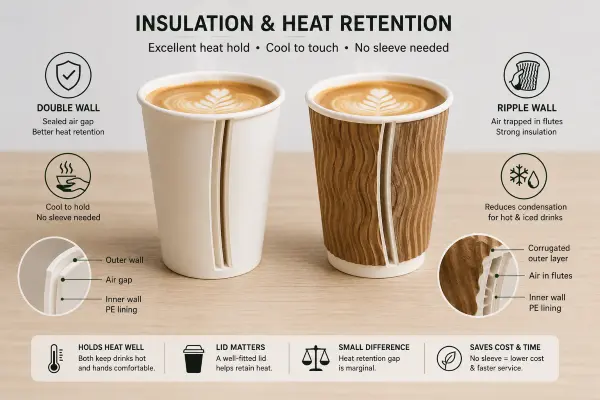
Both constructions hold heat well and keep the outer surface cool enough to hold without a sleeve. Double wall retains heat marginally longer because its sealed air gap is continuous around the cup; ripple wall performs strongly because air is trapped throughout the flutes. Picture both as a thermal jacket around the drink: double wall seals the jacket seamlessly, while ripple quilts it. The gap between them is small, and for espresso-based drinks, filter coffee, and tea alike, either construction is enough, so heat retention alone rarely decides the choice.
Board weight, drink temperature, and a well-fitted lid affect hot-hold more than the wall type does. Both cups also remove the sleeve, which cuts a line item and a serving step at the counter. The same trapped air helps with cold and iced drinks too: the outer wall slows condensation, so the cup stays drier in the hand and on the counter than a single wall would. If your menu leans on very hot, long-carry drinks, both work; for a closer look at hot-drink performance, see are ripple cups better for coffee and best paper cups for hot drinks.
Grip, Feel and Durability
Ripple wall gives a firm, non-slip grip through its textured surface, which suits busy, high-turnover, and mobile service; double wall gives a smoother, more classic feel that reads as premium in a sit-in cafe. The grip is the first physical contact a customer has with your brand, so the surface is part of the experience, not only the engineering.
On durability, both cups resist crushing far better than single wall, and both stack neatly for storage and transport. Ripple gains edge rigidity from its flutes, while double wall gains it from a continuous, sealed second wall and a stronger rolled rim. In practice, that means fewer cups crushed in delivery, cleaner one-handed carrying, and less waste in the stockroom, especially when cups travel in carrier trays.
Branding and Print Quality
The outer surface decides print quality. Double wall’s smooth wall carries full-wrap logos, fine detail, and multiple colours cleanly and consistently, which suits chains, premium cafes, and corporate catering that need a uniform look across sites. Ripple wall’s textured surface delivers a standout rustic aesthetic and a lovely grip, though small print detail reads a little softer against the ripples; simple, high-contrast logos work best on it.
With EcoLife print on demand paper cups and low minimum order quantities, you can add your logo without committing to container-sized runs or holding dead stock. Dispatch runs within 24 hours, and first wholesale orders carry a 20% discount. Prepare artwork to the print area before you order; the guide to branded paper cups and the minimum order for printed cups pages walk through both.
Cost and True Cost-per-Serve
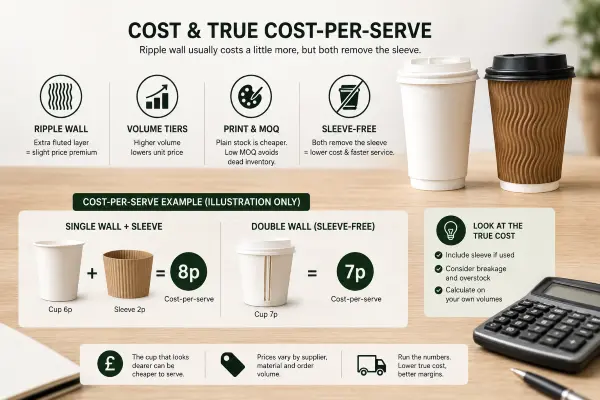
Ripple wall usually costs a little more per unit than double wall because of the extra fluted layer, though the gap is small and shifts with supplier and volume, so industry sources do not agree on a fixed figure. Order in tiers, and the per-unit price falls as volume rises. Plain stock costs less than printed stock, and a low MOQ keeps your cash out of dead inventory, so the headline unit price is only part of the picture.
Because both cups remove the sleeve, compare cost-per-serve, the cost of the cup plus a sleeve only if you add one, rather than unit price alone. As an illustration only: a single wall cup at 6p plus a 2p sleeve costs 8p to serve, while a sleeve-free double wall at 7p serves for 7p, so the cup that looks dearer can be cheaper in practice. Factor in breakage and overstock too, then run the numbers on your own volumes. For a full breakdown, see cost per paper cup, wholesale paper cups UK, and low MOQ paper cups.
Materials, Eco and What You Can Claim in the UK
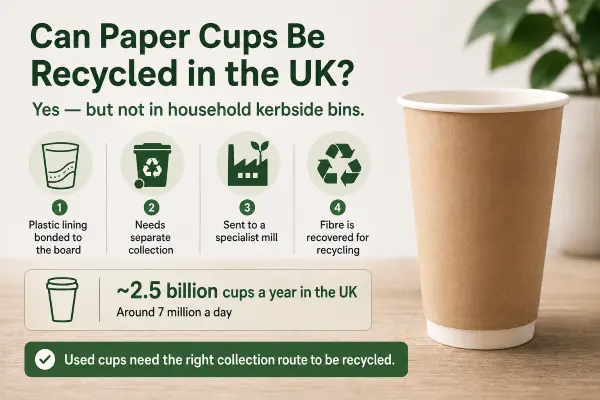
The lining decides eco credentials more than the wall type does. EcoLife cups use a PE lining on both ripple and double wall for waterproofing, durability, and heat resistance; some other suppliers instead use PLA or water-based coatings on these cups. Under UK conditions, most paper cups are around 95% paper fibre with a roughly 5% polyethylene lining bonded under high heat, which is what keeps them waterproof and what makes standard recycling difficult (UK Parliament, Environmental Audit Committee).
Because of that lining, PE-lined cups are recyclable only through specialist facilities that separate the fibre from the plastic, not through most household or on-the-go kerbside bins, and they must be collected as a separate waste stream (National Cup Recycling Scheme). Fewer than 1 in 400 disposable cups are currently recycled in the UK, which shows why honest wording matters (UK Parliament, Environmental Audit Committee). Note: lids are a separate material, usually PP plastic, and follow their own local rules.
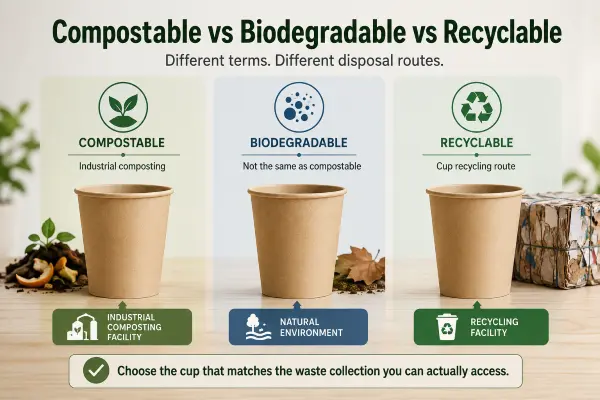
For PE-lined cups, avoid widely recycled, compostable, and plastic-free; state the recycling condition plainly, and substantiate every environmental claim under the CMA Green Claims Code, which requires claims to be truthful, clear, evidenced, and not to omit important information. If a supplier advertises a cup as compostable, ask for the certification before you repeat the claim. To understand the linings, compare PLA vs PE lining, and for the recycling route see how to recycle paper cups UK and are kraft ripple cups recyclable.
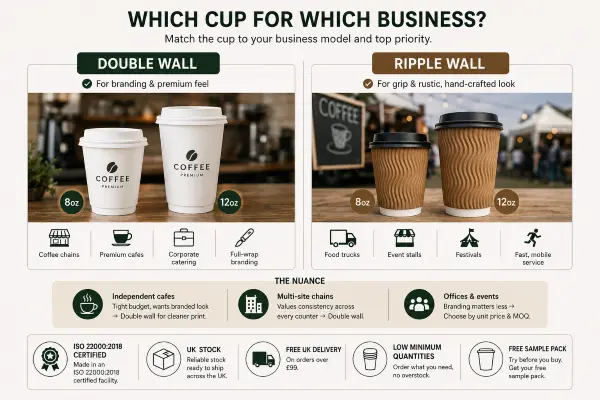
Which Cup for Which Business?
Match the cup to your model and your top priority. The two clear paths are:
- Choose double wall for consistent, sharp branding and a premium feel: coffee chains, premium cafes, corporate catering, and any order that needs full-wrap detail. Both 8oz double wall and 12oz double wall suit standard hot menus.
- Choose ripple wall for firm grip and a rustic, hand-crafted look: food trucks, event stalls, festivals, and fast, mobile service. Both 8oz ripple and 12oz ripple carry the natural kraft aesthetic well.
The nuance sits in between. An independent cafe on a tight budget that still wants a branded look often lands on double wall for its cleaner print, while a multi-site chain values double wall for consistency across every counter. Offices, staff kitchens, and one-off events tend to favour whichever unit price and MOQ fit the volume, since branding matters less there.
How Do You Switch Cups Without Wasting Money?
You now know which cup fits your business; the rest is avoiding the costly traps when you order or make the switch.
Mistakes to Avoid When Choosing Between Ripple and Double Wall
Four mistakes quietly cost cafes money when they change cups:
- Choosing on looks alone, without checking that the print surface and grip suit your menu and service style.
- Repeating compostable or 100% recyclable marketing, which risks a CMA Green Claims Code breach on your own packaging or menu.
- Over-ordering to clear a high MOQ, then holding stock you cannot use before it is needed.
- Forgetting to match lids to cup size, which wastes both cups and lids. Confirm cup lid size compatibility before you order, and pair double wall cups with lids for double wall cups.
Frequently Asked Questions
Which Keeps Coffee Hotter, Ripple Wall or Double Wall Cups?
Both keep coffee hot. Double wall holds heat marginally longer thanks to its continuous sealed air gap, while ripple wall protects the hand well through its textured, fluted surface. The difference is small, and either suits most hot drinks.
Can You Print a Logo on Ripple Wall Cups?
Yes. Because the surface is textured, small print detail reads a little softer than on smooth double wall, which carries full-wrap detail more sharply. Simple, high-contrast logos print cleanly and look striking on ripple wall.
Are Ripple and Double Wall Paper Cups Recyclable in the UK?
Conditionally. Both are paper with a PE lining, so they are not accepted in most household bins and need specialist facilities that separate the lining from the fibre. Collect them as a separate stream, and avoid the phrase widely recycled.
Which Paper Cup Is Best for a Takeaway Coffee Shop?
It depends on your priority: choose double wall for sharp, consistent branding, or ripple wall for firm grip and fast service. Both come in 8oz for smaller coffees and 12oz for larger, with lids matched to each size.
Sources