Currently Empty: £ 0.00

A paper coffee cup is paperboard fitted with a thin waterproof lining that touches your drink. The honest answer to whether it harms you is conditional, not a flat yes or no: risk depends on the lining material, the temperature of the drink, and how often you use one.
Laboratory work shows plastic-lined cups shed microplastic particles into very hot liquid, yet a food-grade cup sold in the UK sits inside a legal safety framework. This article settles three questions: what leaches from the lining, what UK food-safety rules require, and how to pick a lower-risk cup. EcoLife Packaging, a UK paper-cup supplier, writes this from manufacturing experience.
The first question every reader has is whether the cup is safe at all.
Are Paper Coffee Cups Safe to Drink From?
A food-grade paper cup sold in the UK is legally required to be safe for its stated use, and occasional use carries low risk. UK law treats a cup that touches a drink as a food-contact material, so it must pass defined safety and migration checks before it reaches a customer.
Safe, though, is not the same as inert. Laboratory studies record measurable migration of microplastics and trace substances from plastic linings when very hot liquid sits in the cup for several minutes.
The real axis of concern is a one-off takeaway against repeated daily use, since exposure accumulates with frequency and temperature. What the cup is made of decides that risk, so the material comes first.
What Is a Paper Coffee Cup Made Of?
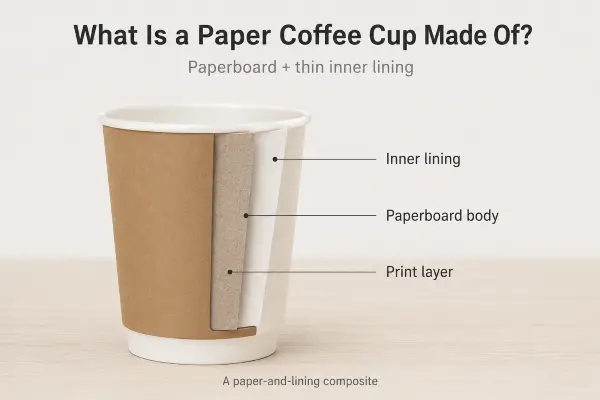
A paper coffee cup is a composite of paperboard and a thin inner lining, not paper alone. The outer body is food-grade paperboard, typically 250 to 350 GSM (grammes per square metre), which gives the cup its rigidity and shape. A thin film bonded to the inside holds the liquid, and an outer print layer carries any branding.
Listed from most to least material by mass, the cup is the paperboard body, the inner lining, and the print. The lining is the smallest layer and the one that decides both safety and recyclability. For the full material breakdown, see What Are Paper Cups Made Of.
Reading the cup as a paper-and-lining composite explains why a thin film always sits between your drink and the board.
Why Paper Coffee Cups Need a Waterproof Lining
A waterproof lining exists because untreated paperboard absorbs liquid and loses its structure within minutes. Paper fibres swell on contact with a hot drink, so a barrier film is bonded to the inner wall to keep the cup rigid and leak-free for the time a drink is held.
That same barrier is the surface your hot drink touches directly. Lining choice, then, governs what can migrate into the liquid, which is why the material of the film matters more than the paper around it. Not every lining uses the same material.
PE, PLA and Water-Based Linings: Which One Touches Your Drink?
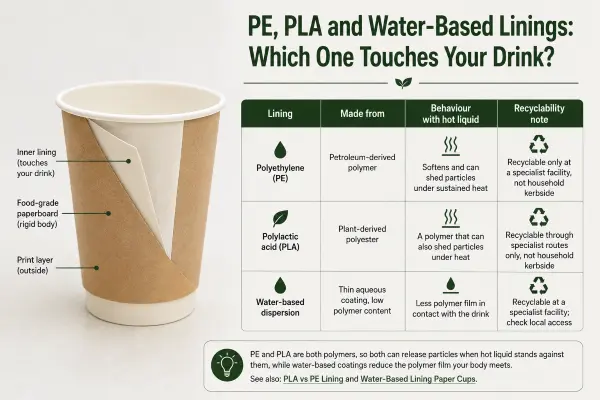
| Lining | Made from | Behaviour with hot liquid | Recyclability note |
| Polyethylene (PE) | Petroleum-derived polymer | Softens and can shed particles under sustained heat | Recyclable only at a specialist facility, not household kerbside |
| Polylactic acid (PLA) | Plant-derived polyester | A polymer that can also shed particles under heat | Recyclable through specialist routes only, not household kerbside |
| Water-based dispersion | Thin aqueous coating, low polymer content | Less polymer film in contact with the drink | Recyclable at a specialist facility; check local access |
PE and PLA are both polymers, so both can release particles when hot liquid stands against them, while water-based coatings reduce the polymer film your body meets. Most microplastics research to date tested PE-lined cups. A side-by-side of the two plastic films appears in PLA vs PE Lining, and the low-polymer option in water-based lining paper cups.
Having named the linings, the concern that put paper cups in the news follows: microplastics.
Do Paper Coffee Cups Release Microplastics Into Your Drink?
Yes. Peer-reviewed work shows plastic-lined cups shed microplastic particles into hot liquid. The leading figures come from a 2020 study by the Indian Institute of Technology Kharagpur, published in the Journal of Hazardous Materials by Ved Prakash Ranjan, Anuja Joseph and Sudha Goel.
The team tested unused cups from five manufacturers and confirmed particle release under fluorescence microscopy. The quantity, and the reason heat drives it, sit in the two questions below. Whether a cup holds a plastic layer at all is covered in Do Paper Cups Have Plastic.
How Many Microplastics End Up in One Hot Drink?
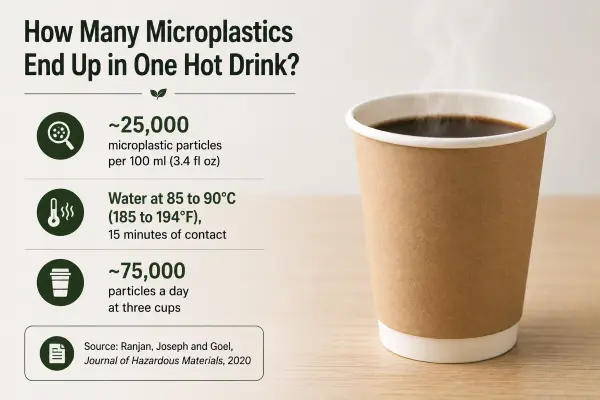
The IIT Kharagpur team measured roughly 25,000 micron-sized microplastic particles released into 100 ml (3.4 fl oz) of water held at 85 to 90°C (185 to 194°F) for 15 minutes. For someone drinking three cups a day, that scales to about 75,000 particles daily.
Electron microscopy detected a far larger load of sub-micron particles in the same volume, below the size the human eye or a standard microscope resolves. The measured particles ranged from 10 to 1,000 micrometres. These figures describe one controlled test, not every cup in every condition.
~25,000 microplastic particles per 100 ml (3.4 fl oz)
Water at 85 to 90°C (185 to 194°F), 15 minutes of contact
~75,000 particles a day at three cups
Source: Ranjan, Joseph and Goel, Journal of Hazardous Materials, 2020
The next question is what happens to the lining to produce them.
What Happens to the Lining When It Meets Hot Liquid?
Sustained heat and contact stress the thin film, forming microscopic cracks from which particles detach into the drink. The IIT Kharagpur work recorded this degradation within 15 minutes of hot water sitting in the cup, alongside a measured drop in the carbon, hydrogen and nitrogen content of the film.
Longer standing time and higher temperature raise the release, so a drink left to cool in the cup transfers more than one finished quickly. Decanting the drink or drinking it promptly lowers what reaches your body.
Having covered plastic particles, the same lining can carry non-plastic substances too.
What Chemicals and Metals Can Migrate From a Paper Cup?
The same IIT Kharagpur analysis detected ions and trace metals tied to the lining films, not the plastic alone. Fluoride, chloride, sulphate and nitrate ions were released into the hot water, and traces of heavy metals, including lead, chromium and cadmium, were found in the films and can transfer at high temperature.
Detection in a lining is not the same as a harmful dose in a drink. A regulated food-grade cup is tested against migration limits set in UK law, covered later in this article.
Two chemicals dominate reader questions, so each takes its own answer next: BPA and PFAS.
Do Paper Coffee Cups Contain BPA?
Standard PE and PLA cup linings do not contain bisphenol A (BPA). BPA is associated with polycarbonate plastics and epoxy resins, not the polyethylene or polylactic acid film used to line a cup, so the chemistry that produces BPA is absent from a standard lining.
BPA in food-contact coatings is separately restricted in the UK under assimilated Regulation 2018/213. A cup lined with PE or PLA is not a BPA source, though a full material check still rests on supplier documentation, as set out in Do Paper Cups Contain PFAS or BPA.
The next coating is a live regulatory question: PFAS.
Do Paper Coffee Cups Contain PFAS?
Per- and polyfluoroalkyl substances (PFAS) have historically been used as grease- and water-resistant coatings in some paper food packaging, though they are not required for a hot-drink cup. PFAS are a family of persistent synthetic chemicals under tightening scrutiny in the UK and EU because they remain in the body and the environment for a long time.
A hot-drink cup holds liquid through its lining, not through a PFAS grease-proofing layer, so a supplier can specify PFAS-free stock. A food-grade specification and a supplier declaration of compliance are how a buyer confirms what reaches your body.
Having covered particles and chemicals, the practical weight of this evidence on health follows.
What Are the Actual Health Risks of Drinking From Paper Cups?
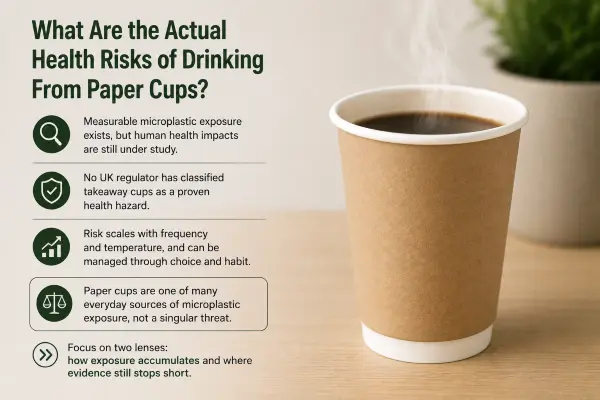
Measurable exposure to microplastics from plastic-lined cups exists, but the human health consequences of that specific exposure are still under study, and no UK regulator has classified takeaway cups as a proven health hazard. The IIT Kharagpur authors framed their own findings as a potential future risk, not an established harm.
The defensible reading is a risk that scales with frequency and temperature, and one you can address through cup choice and habit. That places paper cups among many everyday sources of microplastic exposure rather than a singular threat.
Two lenses sharpen this: how exposure accumulates and where the evidence still stops short.
Occasional Use vs Daily Use: How Exposure Adds Up
A weekly takeaway coffee and several cups a day sit at very different points on the exposure scale. At the study’s figure of about 75,000 particles a day for three cups, intake tracks directly with how often you drink from a lined cup.
Microplastics have been detected widely across the human diet and body, from bottled water to salt and seafood, so a paper cup is one contributor among many. Frequency, more than any single cup, decides your share. The science has not settled every question, which the next point sets out plainly.
What the Evidence Does Not Yet Prove
No established causal link connects paper-cup use to cancer or a specific disease in humans. Laboratory migration of microplastics, ions and trace metals is documented, but a dose-response relationship in people is not, and viral claims that cups cause cancer run ahead of the data.
Treating precaution as reasonable rather than urgent matches the current evidence. You can lower exposure sensibly without treating an occasional coffee as a hazard. With the risk fairly stated, UK rules set the safety floor every compliant cup clears.
How Are Paper Coffee Cups Regulated for Food Safety in the UK?
A cup that touches a drink is a food-contact material, governed in the UK by a stack of assimilated regulations rather than left unregulated. The framework rule, assimilated Regulation (EC) 1935/2004, states that constituents must not transfer to food in amounts that could endanger human health or change the food’s taste, smell or composition.
Plastic components fall under assimilated Regulation (EU) 10/2011, which sets specific migration limits, mandates migration testing, and requires a supplier declaration of compliance. Good manufacturing practice is required by assimilated Regulation (EC) 2023/2006, and the Materials and Articles in Contact with Food (England) Regulations 2012 apply nationally.
The Food Standards Agency maintains the authorised-substance lists, and local authorities enforce compliance. A compliant cup is tested against these defined limits before sale. Regulation sets the floor; picking a cup that clears it comfortably is the practical next step.
How Do You Choose a Paper Coffee Cup That Is Safer to Drink From?
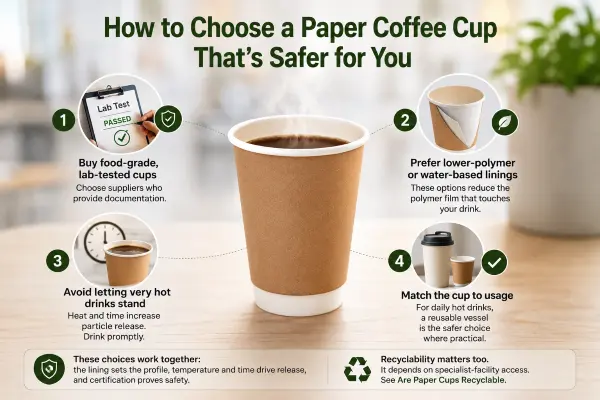
Choosing a lower-risk paper cup comes down to lining, certification, temperature and how often you use it. Ordered by impact, four choices lower exposure.
- Buy food-grade, lab-tested cups from a supplier that provides documentation.
- Prefer a lower-polymer or water-based lining where the use case allows.
- Avoid leaving very hot drinks standing in the cup; decant or drink promptly.
- Match the cup to usage, and reserve daily hot drinks for a reusable vessel where practical.
Each choice traces back to a point proven above: the lining sets the profile, temperature and time drive release, and certification evidences safety. Recyclability sits alongside these and depends on specialist-facility access, covered in Are Paper Cups Recyclable.
These choices raise the everyday questions readers still ask, answered next.
Common Questions About Paper Coffee Cup Safety
A short set of frequent questions rounds out the picture, each answered directly below. These reinforce the main analysis without repeating it.
Are Paper Cups Safe for Hot Drinks?
Yes, with one condition. Food-grade cups are made and rated for hot drinks and are safe for normal takeaway use, while very hot liquid left standing for several minutes raises migration, so drinking promptly is the sensible habit. Fuller guidance sits in Are Paper Cups Safe for Hot Drinks.
Are Paper Coffee Cups Microwave Safe?
Most disposable cups are not intended for microwaving. Concentrated microwave heat can stress the lining and any glue or print, so transferring the drink to a microwave-safe vessel is the safe course unless the cup is explicitly labelled otherwise. See Are Paper Cups Microwave Safe for the detail.
Which Cup Is Healthiest: Paper, Plastic or Reusable?
The healthiest cup depends on how and how often you use it, not a fixed ranking. A reusable stainless steel or glass cup avoids single-use linings and suits daily home or desk use.
A food-grade paper cup suits on-the-go service, where the advantages of disposable paper cups, single-use hygiene, no shared washing, and convenience, carry real weight for low occasional risk. Plastic cups bring their own migration and disposal questions. A fuller comparison sits in Reusable vs Disposable Cups.
Do Plastic-Free Paper Cups Exist?
Cups described as plastic-free usually use a water-based dispersion lining that sharply reduces the polymer film, rather than removing plastic altogether. Such cups are the closest current option to a plastic-free cup, though the term is often applied loosely, and recyclability still depends on specialist-facility access. What the label means is unpacked in What is plastic-free paper cup.
What Makes a Paper Coffee Cup Safe Rather Than Bad for You?
A paper coffee cup is safe rather than bad for you when it is food-grade and documented, uses a lower-polymer or well-tested lining, is not left holding very hot liquid, and is used in moderation. Those four conditions map onto the evidence: certification for legal safety, lining for the migration profile, temperature discipline for release, and frequency for cumulative exposure.
That returns to the opening answer. The verdict was never a flat yes or no; it turned on the lining, the heat and the habit, all of which you control. Choosing certified stock is the small, practical step that settles the question.
Sources
Ranjan, V. P., Joseph, A. and Goel, S. (2020). Microplastics and other harmful substances released from disposable paper cups into hot water. Journal of Hazardous Materials, 404, 124118 (PubMed).
Food Standards Agency. Food contact materials guidance (assimilated Regulations 1935/2004, 10/2011, 2023/2006).